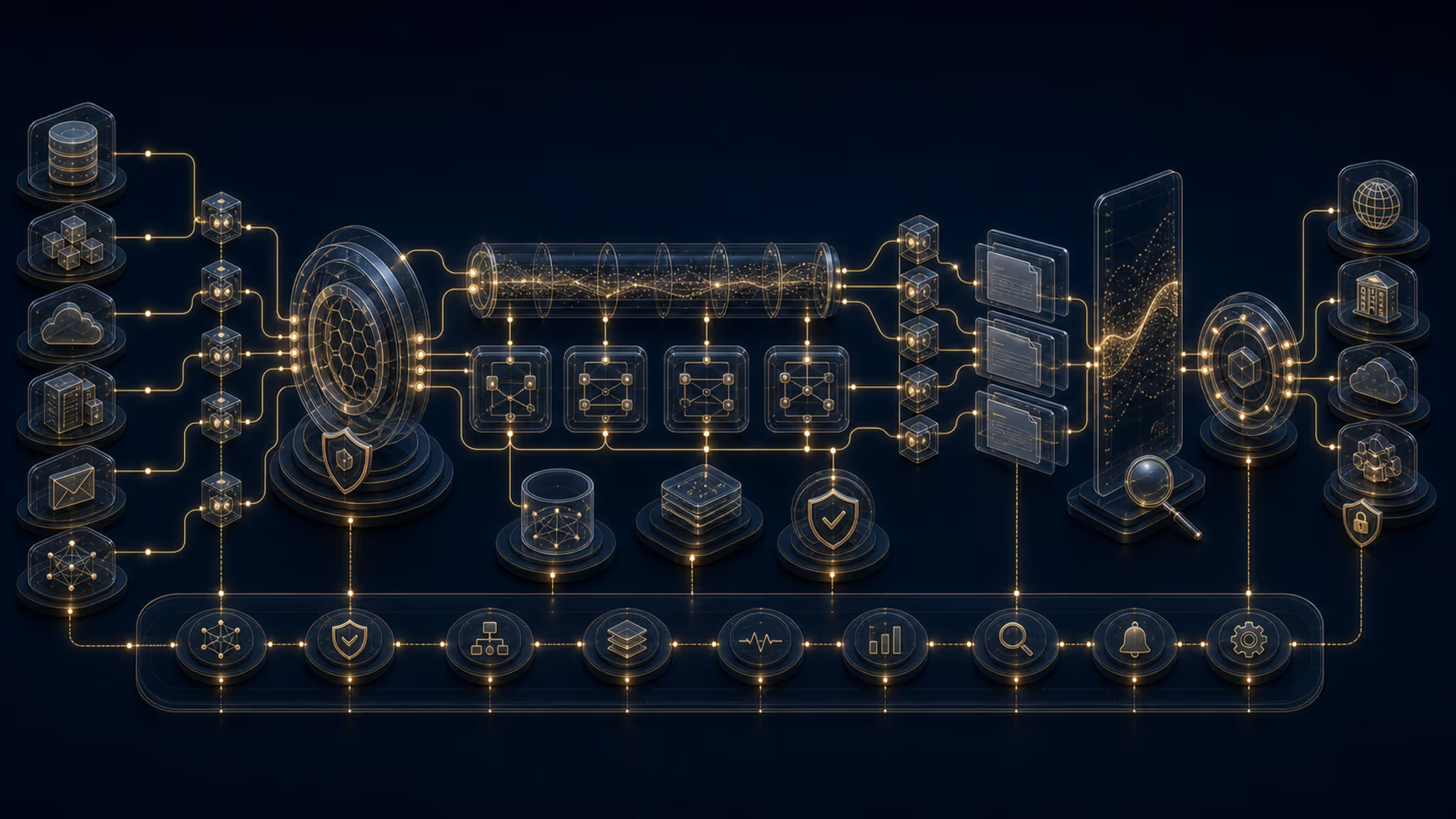
We automate data flow between systems; an API management platform and iPaaS solutions remove integration complexity.
EVIDENCEISO 27001OWASP ASVSScope recordRisk note
01Current stateTopology, traffic, and dependency visibility.
02Target architectureSegmentation, capacity, and availability design.
03Controlled cutoverChange window, validation, and rollback plan.
04HypercareMonitoring, tuning, and operational handover.
POSITION
Where this service sits in the portfolio
SERVICE SCOPE
What this service addresses
The critical topics this service addresses and the outcome we deliver in each.
Automated data flow
contract-scoped
We automate data flow between systems, making operational time and quality indicators measurable through acceptance criteria, with the aim of reducing errors tied to manual transfer.
Centralized security and access
evidence readiness
Centralized security and access control are established through the API gateway over OAuth 2.0, API key, mTLS and CORS; usage limits are made manageable with tier-based rate limiting.
Faster integration onboarding
measured target
The notable acceleration of onboarding new integrations through iPaaS and ready connectors is tracked together with a baseline measurement and target.
Proactive integration monitoring
published after approval
Making integration health proactively visible through latency, error-rate and throughput monitoring, and verifying SLA targets over contracted scope, is determined together with the customer.
Delivery model
Delivery approach
How we phase the service across delivery, governance, and connected service pillars.
01
Work starts with integration-needs analysis and architecture design; consistent, documented APIs are designed with a design-first, contract-driven approach.
02
A central management layer is established with API gateway security and rate-limiting configuration; existing point-to-point integrations are converted to standard APIs incrementally rather than replaced at once.
03
Event-driven integration is built over RabbitMQ, Kafka or Azure Service Bus; error cases are handled with dead-letter-queue, retry and compensating-transaction patterns, and are logged with alerts sent.
Operating contexts
Example operating contexts
Illustrative surfaces where this service is commonly activated.
Removing data silos
Turning manual data transfer between systems such as ERP, CRM and accounting into an automated, observable flow.
Controlled API for partners
Opening secure, controlled API access to external partners through a partner portal, API-key management and usage quotas.
Legacy integration modernization
Bringing existing point-to-point integrations under central management with an API gateway and standardizing them incrementally.
DEPTH
Technical and compliance depth
This service's depth on sector-specific technical and compliance topics.
API standards and protocols
REST is used for standard CRUD, GraphQL for complex data and mobile scenarios, and gRPC for high-performance microservice communication. Standards are OpenAPI 3.1, AsyncAPI and gRPC protobuf.
Gateway and iPaaS
Azure API Management, Kong or AWS API Gateway for the gateway; Azure Logic Apps, MuleSoft, Boomi or n8n for iPaaS. Versioning runs with semantic versioning and a deprecation policy.
Deliverables
A configured and secure API gateway, iPaaS or custom integration flows, a Swagger UI / Redoc-based developer portal, and a monitoring dashboard with alert configuration on Grafana / Datadog / Application Insights are delivered.
What It Solves
Enterprise organizations operate dozens of disconnected applications — ERP, CRM, HRMS, e-commerce platforms, and SaaS tools — each with its own data model and integration interface, creating a fragile web of point-to-point connections that breaks with every upgrade and slows new capability delivery. Our API & Integration (iPaaS) practice designs and implements enterprise integration architectures that replace brittle custom integrations with governed, scalable, and observable API ecosystems. We specialize in API management platform deployment, event-driven architecture design, and iPaaS orchestration that reduces integration complexity while increasing reliability and developer productivity.
Enterprise API management platform deployment on Azure API Management, Kong Enterprise, or MuleSoft Anypoint
Event-driven integration architecture using Apache Kafka, Azure Service Bus, or AWS EventBridge
iPaaS workflow orchestration for system-to-system process automation with retry logic and dead-letter handling
API governance framework with versioning standards, deprecation policies, and consumer SLA management
Key Benefits
Benefit
Turn the outcome into a measurable target with baseline, owner, and review cadence
Benefit
Accelerate new integration development from weeks to days using reusable API connectors and integration templates
API Management
Azure APIM, Kong Enterprise, MuleSoft Anypoint, AWS API Gateway
Messaging
Apache Kafka, Azure Service Bus, RabbitMQ, AWS SQS/SNS, AWS EventBridge
OpenAPI 3.1, AsyncAPI 2.6, CloudEvents 1.0, SOAP/WSDL, EDI X12/EDIFACT
Scope
Our iPaaS and API integration engagements begin with an integration landscape assessment mapping all current point-to-point connections, quantifying maintenance burden, and identifying consolidation opportunities. We then design a target integration architecture, select the appropriate platform, and implement integrations in priority order based on business impact. Full API lifecycle management — design, testing, publishing, versioning, and deprecation — is established as a governed process.
Integration landscape discovery and current-state mapping with maintenance cost quantification
API design-first methodology using OpenAPI specification with contract testing via Pact or Spring Contract
Event streaming platform setup with topic governance, schema registry, and consumer group management
Developer portal with API catalog, interactive documentation, sandbox environment, and subscription management
Key Benefits
Benefit
Turn the outcome into a measurable target with baseline, owner, and review cadence
Benefit
Turn the outcome into a measurable target with baseline, owner, and evidence review cadence
Benefit
Turn the outcome into a measurable target with baseline, owner, and review cadence
Deliverables include a production-deployed integration platform with API catalog, monitoring dashboards, and governance documentation. Every API is published with OpenAPI 3.1 documentation, integration test suites, and runbooks. The API governance framework document defines standards for API design, versioning, deprecation, and consumer onboarding that your team can apply independently to future integrations.
Production API management platform with developer portal, consumer subscriptions, and usage analytics
Integration platform with deployed connectors, documented workflows, and error handling runbooks
API Governance Framework covering design standards, versioning, deprecation, and consumer SLA policies
Integration observability dashboard with end-to-end message tracing, SLA compliance metrics, and error rate alerting
Key Benefits
Benefit
Publish a self-service developer portal enabling both internal and partner API consumers to onboard independently
Benefit
Shorten operational cycle time against agreed measurement targets and acceptance criteria
Benefit
Apply consistent API design standards across all future integrations using the delivered governance framework
API Design Guide, versioning policy, deprecation process, consumer onboarding checklist
Frequently Asked Questions
What is the difference between API management and iPaaS, and which do we need?
API management platforms (Azure APIM, Kong) govern, secure, and expose APIs consumed by internal or external developers — handling authentication, rate limiting, analytics, and developer portal publishing. iPaaS platforms (MuleSoft, Logic Apps) orchestrate multi-step integration workflows between systems, handling data transformation, routing logic, and process automation. Most enterprise integration strategies require both: API management for the API layer and iPaaS for process orchestration.
How do you handle integration with legacy systems that have no modern API?
We implement adapter patterns for legacy connectivity: database-level integration for systems exposing no API (using CDC — Change Data Capture — via Debezium for real-time streaming), file-based integration for batch-oriented legacy systems (SFTP, AS2, EDI), and screen-scraping RPA connectors as a last resort for systems with no programmatic interface. Each legacy adapter is wrapped in a modern REST or event API facade for consumption by downstream systems.
How do you manage breaking changes in APIs without disrupting existing consumers?
We implement a versioning governance policy: non-breaking changes (additive fields, new optional parameters) are backward-compatible and deployed without version bumps; breaking changes require a new major API version with a deprecation notice period (minimum 6 months) and a migration guide for existing consumers. The API management platform routes traffic to the appropriate version based on Accept header or URL version prefix.
Can you integrate our on-premises systems with cloud SaaS platforms?
Yes. Hybrid integration is a core capability of our practice. We deploy self-hosted integration gateways (Azure API Management self-hosted gateway, Kong data plane, or MuleSoft Runtime Fabric) within your on-premises network, establishing secure outbound connectivity to cloud platforms without opening inbound firewall ports. Event streaming between on-premises and cloud uses encrypted Kafka MirrorMaker 2 or Azure Event Hubs Kafka protocol compatibility.
How do you secure APIs exposed to external partners or customers?
External API security is implemented in layers: OAuth 2.0 with PKCE for client authentication, mutual TLS (mTLS) for partner-to-partner machine connectivity, API key rotation policies with automated expiry, rate limiting per consumer subscription tier, and DDoS protection through WAF integration (Azure Front Door, Cloudflare, AWS WAF). All API traffic is logged to a SIEM with anomaly detection alerts for unusual consumption patterns.
What integration testing strategy do you recommend for event-driven systems?
Event-driven integration testing requires a layered strategy: consumer-driven contract testing (Pact) verifies that producers honor consumer expectations without requiring live integration, in-memory event broker simulation (Testcontainers with Kafka) enables fast local integration tests, and end-to-end integration test suites using a dedicated staging environment with synthetic event injection validate complete message flows including retry and dead-letter scenarios before production deployment.
Related service groups
Compare the other workstreams under the same pillar as well.