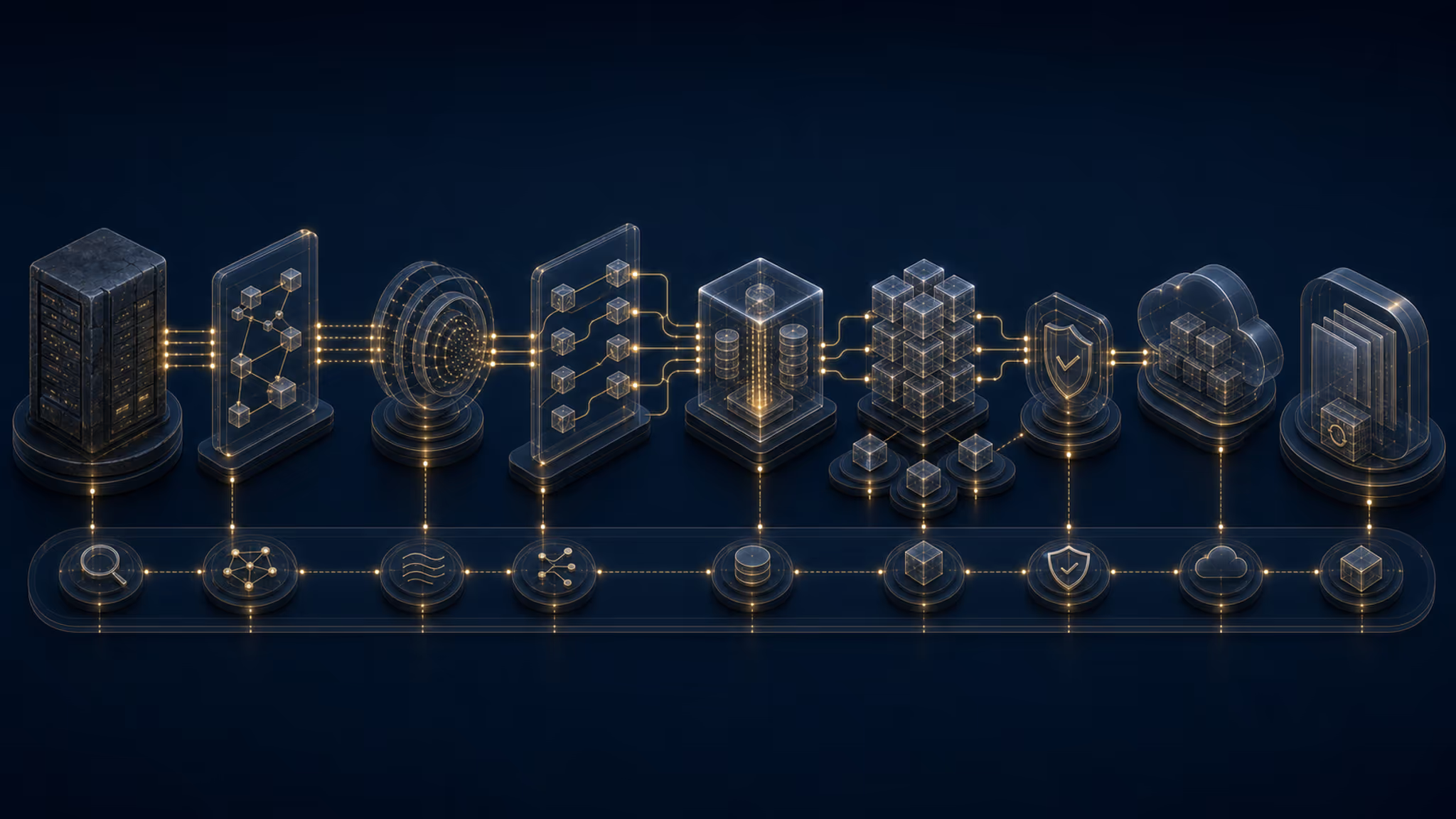
We move legacy systems to cloud-based modern architecture; technical debt and maintenance costs drop while agility rises.
EVIDENCEISO 27001OWASP ASVSScope recordRisk note
01Current stateTopology, traffic, and dependency visibility.
02Target architectureSegmentation, capacity, and availability design.
03Controlled cutoverChange window, validation, and rollback plan.
04HypercareMonitoring, tuning, and operational handover.
POSITION
Where this service sits in the portfolio
SERVICE SCOPE
What this service addresses
The critical topics this service addresses and the outcome we deliver in each.
Low-risk incremental migration
contract-scoped
With the Strangler Fig pattern the old and new systems run in parallel; each phase modernizes one module and retires the old system step by step, distributing the risk of a big migration across modules.
Technical debt you can prioritize
evidence readiness
A technical-debt inventory is produced through static code analysis, dependency mapping and complexity measurement; modules with high business value and maintenance cost are prioritized for planning.
The most suitable strategy per module
measured target
With the 5R framework, a strategy based on cost-benefit analysis is chosen for each module; some modules can be retained as-is, aiming to optimize overall cost.
Verifiable data integrity
published after approval
Verifying the migration through record counts, hash comparison and business-rule tests, and making the output traceable through a baseline measurement, target and evidence record, is defined together with the customer.
Delivery model
Delivery approach
How we phase the service across delivery, governance, and connected service pillars.
01
Work starts with analysis of the existing system and a technical-debt inventory; static code analysis, dependency mapping and complexity measurement prepare the ground for modernization.
02
A 5R assessment is made for each module and the target architecture is designed; the data-migration strategy (ETL, CDC, dual-write) is determined per project, planning parallel running and performance comparison.
03
The transition runs with blue-green or canary deployment; a rollback procedure is prepared for each phase, making a controlled return to the old system possible during the parallel-run period.
Operating contexts
Example operating contexts
Illustrative surfaces where this service is commonly activated.
From monolith to microservices
Incremental transformation of a hard-to-maintain monolith into a microservices architecture with an Anti-Corruption Layer.
Cloud-targeted replatforming
Moving an on-premise application to an Azure, AWS or Kubernetes target with the 5R strategy.
Database modernization
Migrating a legacy database to a modern data layer over data integrity verified with ETL or CDC.
DEPTH
Technical and compliance depth
This service's depth on sector-specific technical and compliance topics.
Strategies and patterns
Rehost, Replatform, Refactor, Rebuild and Replace strategies are assessed per module; Strangler Fig, Anti-Corruption Layer and CQRS patterns are applied. Target platforms can be Azure, AWS and on-premise Kubernetes.
Data migration and verification
Migration runs with ETL, CDC and dual-write approaches; verification is done with record counts, hash comparison and business-rule tests. Phase duration is typically 4-8 weeks per module.
Deliverables
Modernized application modules, a data-migration report with verification results, a cutover plan with rollback procedure and a modern-system operations guide are delivered. A performance baseline is established for the new system.
What It Solves
Legacy systems — often decades-old monoliths built on COBOL, VB6, legacy Java, or early .NET frameworks — accumulate technical debt that manifests as increasing maintenance costs, brittle integrations, security vulnerabilities, and inability to adopt cloud capabilities. Our Legacy System Modernization practice provides structured pathways from aging architectures to cloud-native, maintainable, and secure platforms using proven migration strategies including the Strangler Fig pattern, lift-and-shift with progressive refactoring, and full re-platforming. We minimize business disruption through meticulous migration planning, parallel run validation, and phased cutover strategies.
Legacy portfolio assessment with application classification by business criticality, technical debt score, and modernization ROI
Strangler Fig pattern implementation for incremental microservices extraction without big-bang rewrites
Automated code analysis using Modernization Workbench tools for COBOL, VB6, and legacy Java codebases
Cloud-native re-platforming to .NET 8, Java 21, or Node.js with containerized deployment on Kubernetes
Key Benefits
Benefit
Make cost and resource optimization measurable against the agreed baseline and review cadence
Benefit
Eliminate critical security vulnerabilities from unsupported runtime versions (Java 8, .NET Framework 4.x, COBOL on z/OS)
Benefit
Make operational speed, resilience, and response outcomes measurable through contracted scope and acceptance criteria
Source Languages
COBOL, VB6, VB.NET, Java 6–8, ASP Classic, .NET Framework 2.0–4.8
Our legacy modernization engagements begin with a thorough portfolio assessment that prioritizes applications by modernization value, risk, and interdependency — preventing premature modernization of systems with low ROI or high coupling complexity. We design migration waves grouping applications by affinity and shared data domains, then execute each wave with parallel run validation before decommissioning the legacy version. Data migration, integration re-platforming, and organizational change management are included in scope.
Application portfolio rationalization and wave planning with dependency mapping and sequencing
Database migration strategy covering schema transformation, data migration, and data quality validation
Integration re-platforming from point-to-point legacy interfaces to API-based or event-driven patterns
Parallel run framework enabling side-by-side operation of legacy and modern systems during validation
Key Benefits
Benefit
Prioritize modernization investment with quantified TCO analysis before committing to migration waves
Benefit
Execute migrations with zero unplanned downtime using parallel run validation and automated rollback capability
Benefit
Modernize database layer from legacy RDBMS to cloud-native Azure SQL or PostgreSQL with full data integrity verification
Automated data reconciliation, functional parity test suites, parallel run dashboards
Deliverables
Deliverables include the modernized application deployed in production on cloud-native infrastructure, decommissioning confirmation for legacy systems, migration documentation, and a technical debt reduction report quantifying improvements. A 90-day hypercare period with performance benchmarking ensures the modernized system meets or exceeds legacy performance baselines under production load conditions.
Production-deployed modernized application with cloud-native infrastructure and automated CI/CD pipeline
Technical Debt Reduction Report benchmarking code quality metrics before and after modernization
Legacy system decommissioning plan with data archiving strategy and regulatory retention compliance
Developer knowledge transfer including architecture documentation, codebase walkthroughs, and training sessions
Decommission legacy infrastructure reducing annual licensing and maintenance costs immediately
Benefit
Enable your development team to independently evolve the modernized platform using documented architecture patterns
Code Quality
SonarQube quality gates, CodeClimate maintainability scores, test coverage reports
Infrastructure
Production Kubernetes cluster with GitOps (ArgoCD), monitoring (Prometheus/Grafana)
Data Archival
Cold storage archiving with query capability, GDPR-compliant retention policies
Performance
Load test reports validating parity with or improvement over legacy baseline
Frequently Asked Questions
What is the Strangler Fig pattern and why is it safer than a full rewrite?
The Strangler Fig pattern progressively replaces legacy functionality by routing specific features or API endpoints to new cloud-native services while the legacy system continues handling remaining functions. Over time, the legacy system is gradually 'strangled' as more functionality moves to the new platform. This approach eliminates the risk of big-bang rewrites where the entire system must be replaced at once, allowing business continuity throughout the migration.
How do you handle complex legacy business logic that is poorly documented?
We conduct a legacy code archaeology phase using automated static analysis, execution tracing, and business analyst co-discovery sessions to reconstruct business rule documentation before any code is rewritten. We create a Business Rule Catalog for all discovered rules, validate them with domain experts, and use this as the specification for the modernized implementation — ensuring no undocumented business logic is lost in the transition.
How long does a typical legacy modernization project take?
Timeline depends on system complexity and portfolio size. A single mid-complexity legacy application modernization (100,000–500,000 lines of code) requires a scoped timeline agreed during discovery. Enterprise portfolio modernization programs spanning 10–20 applications are planned over 2–4 years in phased waves, each wave delivering independent business value to justify continued investment.
How do you maintain security compliance during the transition period when both legacy and modern systems are running?
We conduct a security risk assessment for the parallel run period and implement compensating controls: network segmentation, encrypted synchronization with audit logging, and tightened access controls for the legacy system while the modern replacement is validated against the agreed scope.
How do you ensure the modernized application handles the same edge cases as the legacy system?
We implement a comprehensive functional parity test suite derived from the legacy system's production behavior using traffic shadowing or log replay techniques. Critical business scenarios are documented in a Business Acceptance Test (BAT) catalog, reviewed by business domain experts, and executed against both systems in parallel before cutover. The modernized system must pass all BAT scenarios with documented equivalence before go-live approval.
What happens to historical data stored in the legacy system?
Legacy historical data is migrated according to a tiered strategy: hot data (last 3–5 years) migrates to the modern database with full queryability, warm data migrates to cloud archive storage (Azure Blob, AWS S3 Glacier) with metadata indexing for retrieval, and cold data is retained in compliant archives per regulatory requirements. All migration includes data integrity verification using row-count reconciliation and checksum validation.
Related service groups
Compare the other workstreams under the same pillar as well.