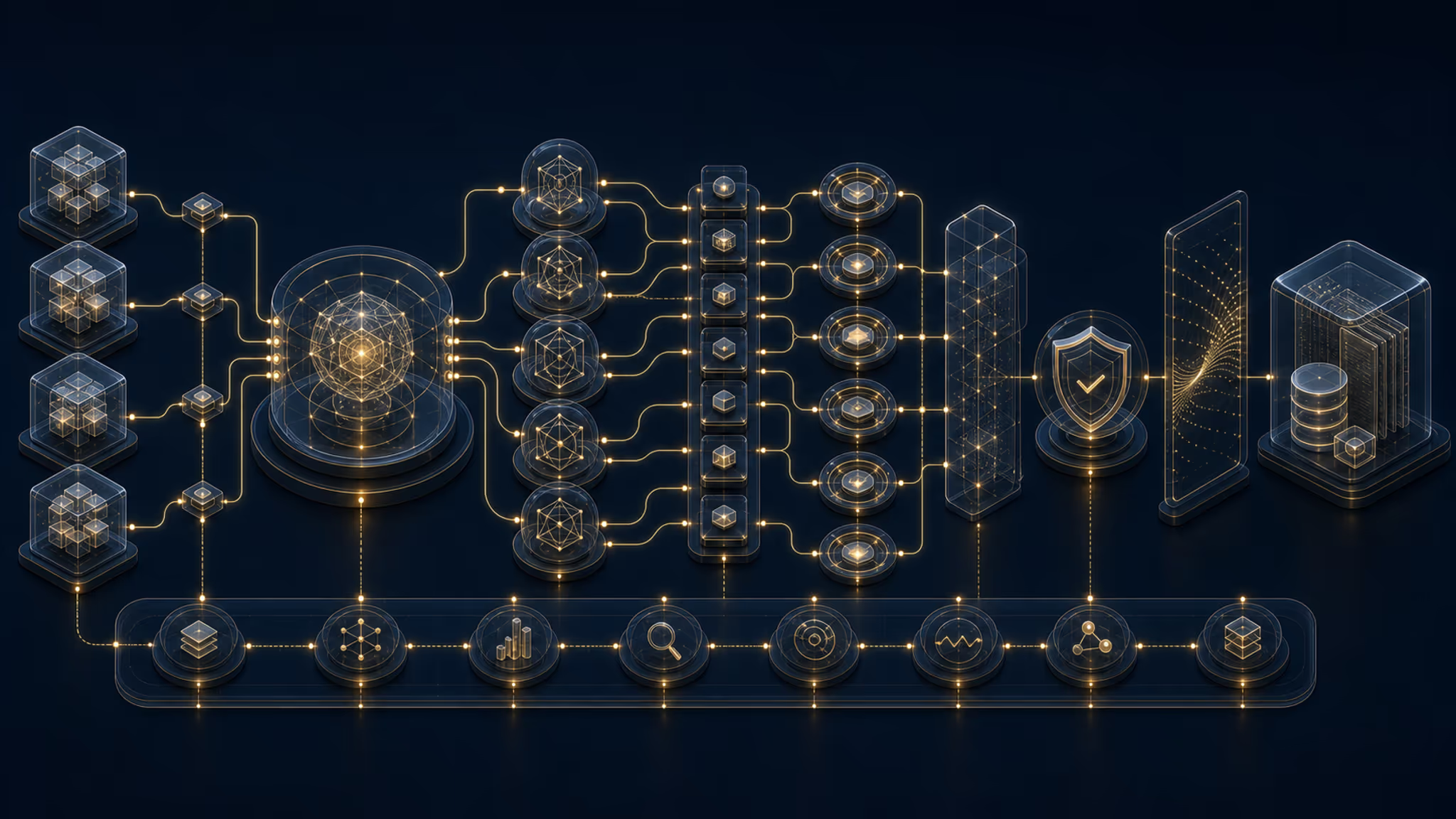
We orchestrate specialized AI agents to solve multi-step processes autonomously; human intervention drops and processes automate end to end.
EVIDENCEEU AI ActISO 27701KVKKGDPR
01Current stateTopology, traffic, and dependency visibility.
02Target architectureSegmentation, capacity, and availability design.
03Controlled cutoverChange window, validation, and rollback plan.
04HypercareMonitoring, tuning, and operational handover.
POSITION
Where this service sits in the portfolio
SERVICE SCOPE
What this service addresses
The critical topics this service addresses and the outcome we deliver in each.
Scenario value measurement
measured target
We derive the ROI projection as a measurable target through real workload measurements within the pilot scope.
Working pilot delivery
contract-scoped
Within the contracted scope we deliver the multi-agent application, orchestration infrastructure and a monitoring dashboard.
Agent behavior evidence
evidence readiness
We validate system outputs as an evidence record through agent behavior testing, scenario replay and regression.
Human approval points
published after approval
At which points human approval is requested before critical decisions depends on the owner's control decision.
Delivery model
Delivery approach
How we phase the service across delivery, governance, and connected service pillars.
01
We analyze the use case and design specialist agent roles such as research, analysis, decision, execution and validation.
02
We build orchestration with frameworks such as LangGraph, CrewAI and AutoGen, agent communication with A2A and MCP protocols, and planning with ReAct and Plan-and-Execute approaches.
03
We ensure security with sandboxing, permission boundaries and audit logs, and place human-in-the-loop control points before critical decisions.
Operating contexts
Example operating contexts
Illustrative surfaces where this service is commonly activated.
Multi-step process automation
We autonomously solve multi-step processes such as RFP response, financial analysis and technical support escalation through agent orchestration.
Validation agent control
We check agent outputs with validation agents and trigger a feedback loop in case of error.
Existing system integration
We run agents with existing enterprise systems through API, database and file system tool integrations.
DEPTH
Technical and compliance depth
This service's depth on sector-specific technical and compliance topics.
Agent memory layers
We support agents' context consistency with short-term session memory, a long-term knowledge layer and shared memory.
Modular extension
With a modular architecture new agents and tools are added easily, and existing agents are reused in new scenarios.
Orchestration protocols
We build a communication layer that supports interoperability goals between agents with standard protocols such as A2A and MCP.
What It Solves
Complex enterprise workflows — such as end-to-end procurement processing, multi-system incident response, or cross-departmental report generation — involve too many steps, systems, and decision points to be handled by a single AI model or a human team efficiently. Multi-Agent AI Systems (MAS) decompose complex tasks into specialized, collaborating AI agents that operate autonomously, coordinate through structured communication protocols, and escalate to human supervisors only when genuinely necessary. Our MAS practice designs, builds, and governs production multi-agent architectures that deliver measurable automation of high-value enterprise workflows.
Agent architecture design using LangGraph, AutoGen, and CrewAI for orchestrated and autonomous multi-agent workflows
Tool-use and API integration layer enabling agents to query databases, call REST APIs, and execute code
Human-in-the-loop (HITL) checkpoints with configurable confidence thresholds and escalation routing
Agent observability platform with full trace logging, decision audit trails, and performance dashboards
Key Benefits
Benefit
Turn the outcome into a measurable target with baseline, owner, and review cadence
Benefit
Shorten operational cycle time against agreed measurement targets and acceptance criteria
Benefit
Support audit and compliance readiness with evidence records instead of unsupported public outcome promises
Our MAS engagements begin with a workflow automation assessment that maps candidate processes by complexity, automation potential, and business value. We then design the agent topology — determining which tasks require specialized agents, which require orchestration, and where human oversight checkpoints are mandatory. Implementation follows an incremental deployment strategy, starting with shadow mode validation before transitioning to autonomous operation.
Workflow automation assessment with effort/value matrix and agent topology design
Specialized agent development for each functional role (research, synthesis, validation, execution)
Inter-agent communication protocol design with shared memory, message queuing, and state management
Shadow mode testing framework comparing agent decisions against human benchmark decisions
Key Benefits
Benefit
Prioritize automation investments with quantified ROI before committing engineering resources
Benefit
Improve quality indicators through baselines, acceptance criteria, and reviewed evidence
Benefit
Turn the outcome into a measurable target with baseline, owner, and review cadence
State Management
Redis, PostgreSQL, Temporal workflow engine for long-running agent tasks
Kubernetes, Azure Container Apps, serverless function triggers
Deliverables
Deliverables include production-deployed multi-agent systems with full observability infrastructure, agent system documentation, and governance frameworks. Each agent is documented with a capability specification describing its role, tools, decision boundaries, and escalation criteria. The MAS governance framework defines agent lifecycle management, model update procedures, and ongoing performance review processes.
Production multi-agent system with Kubernetes deployment, auto-scaling, and health monitoring
Agent capability specifications and system architecture documentation for each deployed workflow
Observability dashboard with per-agent performance metrics, decision trace viewer, and anomaly alerts
MAS governance framework covering agent lifecycle, model updates, and performance review cadence
Key Benefits
Benefit
Deliver measurable automation ROI documentation with before/after workflow performance benchmarks
Benefit
Enable internal teams to extend agent capabilities using documented tool and agent templates
Benefit
Maintain agent system quality through governance framework and quarterly performance reviews
Deployment Artifacts
Helm charts, Terraform modules, Docker images in private registry
Agent Registry, change control process, model version pinning policy
SLA
Contracted service target set by tier, scope, and approved runbook
Frequently Asked Questions
How do you prevent agents from taking unintended or harmful actions?
We implement defense-in-depth safety controls: each agent operates within a defined capability boundary (tool whitelist), high-stakes actions require a secondary confirmation agent before execution, confidence thresholds gate autonomous progression to next steps, and all agent actions are logged immutably for post-hoc review. Production rollouts use shadow mode for 2–4 weeks before live execution.
What types of enterprise workflows are best suited for multi-agent automation?
High-value MAS candidates share common characteristics: multi-step workflows spanning 5+ actions, cross-system data retrieval and synthesis, conditional branching based on retrieved information, and high-frequency execution making human processing a bottleneck. Examples include invoice exception handling, IT incident triage and remediation, competitive intelligence synthesis, and regulatory report compilation.
How do multi-agent systems handle failures mid-workflow?
We design MAS with resilient execution patterns: each agent step is idempotent where possible, failed steps trigger configurable retry logic with exponential backoff, and workflow state is checkpointed persistently so interrupted workflows resume from the last successful step rather than restarting from scratch. Critical failures route to a human escalation queue with full context.
Can agents integrate with our existing enterprise systems like SAP, Salesforce, or ServiceNow?
Yes. We build a tool integration layer providing agents with typed, validated access to your enterprise systems via REST APIs, GraphQL, and ERP-specific connectors. SAP BAPIs, Salesforce SOQL, and ServiceNow Table API are among the most common integrations. All tool calls are rate-limited, authenticated, and logged centrally.
How do you handle model updates without disrupting running agent workflows?
We implement model version pinning in the agent configuration, so model updates require explicit version bumps reviewed through the change control process. Blue-green deployment of updated agent pods allows parallel operation of old and new model versions during the validation window, with traffic shifted only after automated quality gates pass.
What is the expected ongoing maintenance burden after deployment?
After the 90-day hypercare period, ongoing maintenance typically involves: quarterly model performance reviews and retraining as needed, monthly tool integration health checks as upstream API contracts evolve, and on-demand capacity scaling. Managed operations tiers are available covering contract-scoped monitoring, incident response, and proactive optimization.
Related service groups
Compare the other workstreams under the same pillar as well.