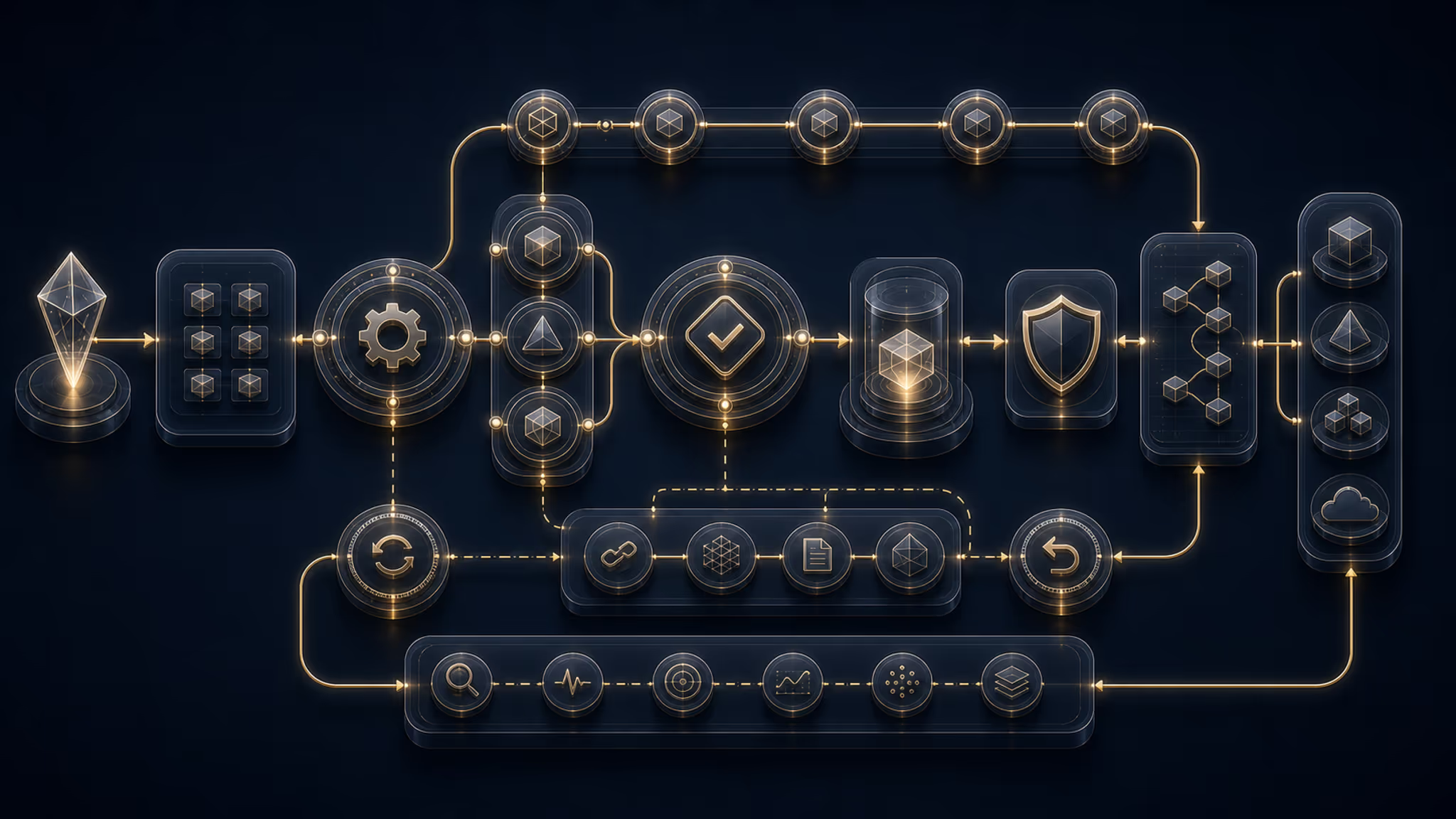
We build continuous integration and deployment pipelines; code changes reach production safely, quickly, and repeatably.
EVIDENCEISO 27001DORAScope recordRisk note
01Current stateTopology, traffic, and dependency visibility.
02Target architectureSegmentation, capacity, and availability design.
03Controlled cutoverChange window, validation, and rollback plan.
04HypercareMonitoring, tuning, and operational handover.
POSITION
Where this service sits in the portfolio
SERVICE SCOPE
What this service addresses
The critical topics this service addresses and the outcome we deliver in each.
A working pipeline is delivered
evidence readiness
We build multi-stage, multi-environment CI/CD pipelines and hand over the working pipeline, environment configurations and an operations guide. The output is evidenced in structured pipeline files.
Quality gates are defined by contract
contract-scoped
We embed unit, integration, SAST and DAST gates into the pipeline; the gate set to be run and its thresholds are defined within contract scope.
DORA metrics are measured
measured target
We baseline deployment frequency, lead time, MTTR and change failure rate, and track improvement against target values; targets are set in the measurement plan.
Independent pipeline ownership is gained
published after approval
Through training and documentation we build your team's capacity to run the pipeline independently; the handover sign-off and knowledge transfer are validated on your side.
Delivery model
Delivery approach
How we phase the service across delivery, governance, and connected service pillars.
01
Current state: we analyse the deployment process, surface bottlenecks and manual steps, and prepare a phased improvement plan without breaking working processes.
02
Pipeline design: we build the multi-stage, multi-environment pipeline (dev/staging/prod) with blue-green, canary and rolling-update strategies and define rollback paths.
03
Quality and security: we embed SAST/DAST/SCA scans into the pipeline with a shift-left approach and guide the move to GitOps and trunk-based development.
Operating contexts
Example operating contexts
Illustrative surfaces where this service is commonly activated.
Manual, error-prone releases
Teams dealing with high error rates and inconsistent environments because they deploy by hand.
Multi-environment drift
Organisations facing differences between dev, staging and prod that need safe releases.
Shifting security into the pipeline
Teams that want to apply shift-left by integrating security scans into the delivery pipeline.
DEPTH
Technical and compliance depth
This service's depth on sector-specific technical and compliance topics.
Multi-stage pipeline architecture
We build automated build, test and deploy stages on GitHub Actions, Azure DevOps, GitLab CI or Jenkins, with blue-green and canary strategies for safe production rollout.
Quality gates embedded in the pipeline
We run static analysis with SonarQube, CodeQL and Semgrep, dynamic scanning with OWASP ZAP, and dependency checks with Trivy and Snyk in parallel and incrementally.
GitOps and environment management
We unify infrastructure and application delivery with ArgoCD or Flux, make environments repeatable with IaC, and deliver operations and troubleshooting guides.
What It Solves
Manual deployment processes create bottlenecks that slow release cycles, introduce human error, and make rollbacks costly and risky. Organizations operating without a mature CI/CD pipeline experience unpredictable release windows, inconsistent environment configurations, and limited visibility into build and deployment health. Our CI/CD and Process Automation service eliminates these friction points by engineering fully automated pipelines that carry code from commit to production with deterministic quality gates at every stage.
Multi-stage pipeline design with parallel execution and fan-out/fan-in patterns
Branch-based deployment strategies including blue/green, canary, and feature-flag releases
Integrated secret management with HashiCorp Vault and cloud-native secret stores
Pipeline-as-code using GitHub Actions, GitLab CI, Azure DevOps, or Jenkins DSL
Key Benefits
Benefit
Shorten operational cycle time against agreed measurement targets and acceptance criteria
Benefit
Eliminate environment drift and configuration inconsistencies across staging and production
Benefit
Make operational speed, resilience, and response outcomes measurable through contracted scope and acceptance criteria
Blue/green, canary, rolling update, feature flags via LaunchDarkly
Scope
The engagement spans the full lifecycle of pipeline design, implementation, and operationalization. We conduct a current-state assessment of your existing build and release processes, identify bottlenecks and compliance gaps, and deliver a target-state architecture aligned to your release cadence goals. Implementation includes pipeline scaffolding, environment promotion logic, rollback automation, and developer experience tooling.
Current-state pipeline audit and maturity scoring against DORA metrics
Target-state architecture design with stakeholder sign-off
Pipeline implementation, testing, and cutover with a controlled, minimal-interruption transition
Developer onboarding documentation and runbook authoring
Key Benefits
Benefit
Turn the outcome into a measurable target with baseline, owner, and evidence review cadence
Benefit
Make operational speed, resilience, and response outcomes measurable through contracted scope and acceptance criteria
Benefit
Make stakeholder confidence, quality, and adoption outcomes traceable through agreed evidence indicators
Assessment Framework
DORA Four Key Metrics (deployment frequency, lead time, MTTR, change failure rate)
Testing Integration
Unit, integration, SAST, DAST, container vulnerability scanning in pipeline
Notification & Observability
Slack, Microsoft Teams, PagerDuty pipeline event hooks with Datadog/Grafana dashboards
Compliance Gates
SOC 2, ISO 27001, GDPR artifact attestation and approval workflows
Deliverables
Every CI/CD engagement concludes with a production-ready, fully documented pipeline that your team owns and operates. We provide all configuration-as-code artifacts, architecture decision records, and operational runbooks needed for long-term self-sufficiency. Post-implementation support is available through our SRE retainer model to ensure stability during the first 60 days in production.
Pipeline-as-code repository with branching strategy, merge policies, and CODEOWNERS defined
Architecture Decision Records (ADRs) for all significant toolchain and strategy choices
Operational runbooks covering common failure scenarios and escalation paths
DORA metrics dashboard configured in Datadog, Grafana, or Azure Monitor
Key Benefits
Benefit
Full knowledge transfer ensures your team can extend and maintain pipelines without external dependency
Benefit
Make risk and response indicators visible through measured controls, rehearsed playbooks, and evidence review
Benefit
Metrics dashboards provide continuous visibility into pipeline health and release velocity trends
Contracted service target set by tier, scope, and approved runbook
Training
Live workshop sessions and recorded video walkthroughs for development and operations teams
Frequently Asked Questions
How long does it take to implement a production-grade CI/CD pipeline?
A baseline pipeline covering build, test, and deploy to a single environment typically takes two to three weeks. Full multi-environment pipelines with security scanning, compliance gates, and progressive delivery strategies are delivered within four to six weeks depending on existing toolchain maturity.
Can you integrate with our existing source control and ticketing systems?
Yes. We integrate with all major source control platforms including GitHub, GitLab, Azure Repos, and Bitbucket, and can link pipeline events to Jira, ServiceNow, or Azure Boards for traceability and change management compliance.
Do you migrate existing pipelines or build from scratch?
We support both approaches. For organizations with existing pipelines, we perform an incremental migration that keeps current releases moving through a defined transition plan while progressively introducing automation, security scanning, and quality gates into the new pipeline structure.
What DORA metrics can we expect to improve?
Clients typically see deployment frequency are measured from the go-live baseline against the agreed go-live baseline. Change failure rate and MTTR improvements depend on the maturity of your testing and monitoring investments made in parallel.
What is included in the post-go-live support period?
The 60-day hypercare period includes unlimited incident support for pipeline failures, two rounds of pipeline optimization based on observed performance data, and one stakeholder review session to validate that DORA metric targets are being met.
Will the pipeline configuration work if we change cloud providers later?
We design pipelines using abstraction layers and cloud-agnostic tooling wherever possible. Platform-specific steps are isolated and documented so that cloud migration requires targeted updates rather than full pipeline rewrites.
Related service groups
Compare the other workstreams under the same pillar as well.