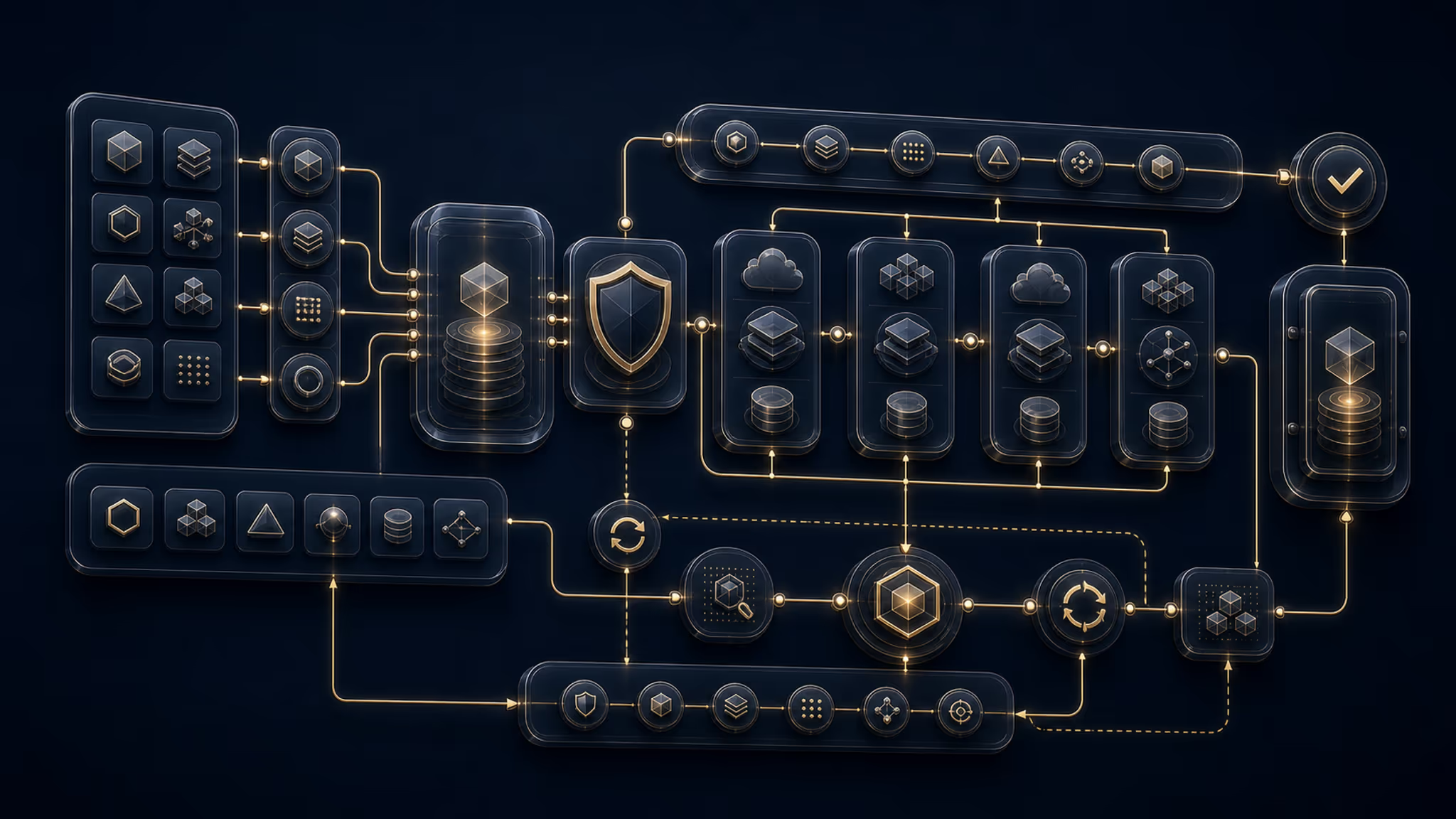
We define all infrastructure as code; repeatable, auditable, version-controlled environment management ends configuration drift.
EVIDENCEISO 27001DORAScope recordRisk note
01Current stateTopology, traffic, and dependency visibility.
02Target architectureSegmentation, capacity, and availability design.
03Controlled cutoverChange window, validation, and rollback plan.
04HypercareMonitoring, tuning, and operational handover.
POSITION
Where this service sits in the portfolio
SERVICE SCOPE
What this service addresses
The critical topics this service addresses and the outcome we deliver in each.
An IaC code base is delivered
evidence readiness
We deliver a Git-based IaC code base, a reusable module library and a plan/apply/destroy pipeline; the output is evidenced in a version-controlled repository.
The approval flow is defined by contract
contract-scoped
We preview changes at the plan stage and apply them after PR review and automated checks plus manual approval; the approval steps are defined within contract scope.
Drift is measured and reduced
measured target
We detect configuration drift with Terraform plan, Azure Policy and OPA and reduce inconsistency across environments against measurable targets.
Independent IaC ownership is gained
published after approval
Through hands-on training and thorough documentation we build your team's capacity to manage infrastructure independently; the handover is validated on your side.
Delivery model
Delivery approach
How we phase the service across delivery, governance, and connected service pillars.
01
Strategy and modules: we set the IaC strategy and build a reusable module library for network, compute, storage and security with semantic versioning.
02
Pipeline and policy: we wire the plan → approve → apply flow into CI/CD and apply security and compliance rules automatically with Policy as Code (OPA/Rego, Azure Policy).
03
State and cost: we prevent concurrent changes with a remote backend and state locking, and track cloud cost by department with Infracost and a tagging strategy.
Operating contexts
Example operating contexts
Illustrative surfaces where this service is commonly activated.
Manual infrastructure management
Organisations facing inconsistent environments and slow provisioning because of manual configuration.
Migrating existing infrastructure to code
Teams that want to convert running infrastructure to IaC gradually and minimise risk.
Multi-cloud standardisation
Organisations that want to standardise Azure, AWS and GCP with a single tool set and module library.
DEPTH
Technical and compliance depth
This service's depth on sector-specific technical and compliance topics.
Module library and versioning
We build network, compute, storage and security modules with Terraform, Bicep or Pulumi and make them reusable through semantic versioning and a registry.
Policy as Code and approval
We codify policies with OPA/Rego, Azure Policy and AWS SCP and ensure safe change through PR review, automated checks and manual approval steps.
State management and drift
We protect state with an Azure Storage, S3 or Terraform Cloud remote backend, state locking and encryption, and detect drift with Terraform plan.
What It Solves
Manually provisioned cloud infrastructure is a source of configuration drift, security exposure, and uncontrolled cost growth. When infrastructure changes are undocumented or made through cloud console click-ops, organizations lose the ability to audit change history, reproduce environments reliably, or recover from failure at scale. Our Infrastructure Automation service transforms your cloud estate into version-controlled, policy-enforced code that can be reviewed, tested, and deployed with the same rigor as application software.
Infrastructure-as-code authoring in Terraform, Pulumi, Bicep, or CloudFormation
Policy-as-code enforcement using Open Policy Agent (OPA) and Sentinel
Drift detection and automated remediation through continuous reconciliation loops
Multi-cloud module libraries covering networking, compute, storage, and identity
Key Benefits
Benefit
Make risk and response indicators visible through measured controls, rehearsed playbooks, and evidence review
Benefit
Turn the outcome into a measurable target with baseline, owner, and review cadence
Benefit
Make cost and resource optimization measurable against the agreed baseline and review cadence
Ansible, Chef, Puppet for OS and middleware configuration automation
Policy Enforcement
Open Policy Agent, HashiCorp Sentinel, Azure Policy, AWS Config Rules
State Management
Terraform Cloud, Atlantis, GitLab-managed state with locking and versioning
Scope
The engagement begins with a cloud estate inventory and maturity assessment that identifies all manually managed resources, configuration drift hotspots, and cost optimization opportunities. We design a modular IaC architecture that maps to your organizational units and environment promotion strategy, then migrate existing resources and establish a GitOps workflow for ongoing infrastructure changes.
Cloud estate discovery and IaC coverage gap analysis across all accounts and regions
Modular IaC library design aligned to organizational structure and environment topology
GitOps workflow setup with pull request review, automated plan output, and approval gates
Cost governance integration with Infracost, AWS Cost Explorer, or Azure Cost Management
Key Benefits
Benefit
Turn the outcome into a measurable target with baseline, owner, and evidence review cadence
Benefit
Enable parallel environment provisioning that reduces developer wait times from days to minutes
Benefit
Establish a verifiable audit trail for every infrastructure change meeting SOC 2 and ISO 27001 requirements
Discovery Tools
Steampipe, AWS Config, Azure Resource Graph for estate inventory
GitOps Engine
Atlantis, Spacelift, or Terraform Cloud for plan/apply orchestration
Cost Analysis
Infracost integrated into PR pipelines for cost impact visibility before apply
Compliance Scanning
Checkov, tfsec, KICS for IaC security and compliance validation
Deliverables
The Infrastructure Automation engagement produces a fully versioned, modular IaC codebase that covers your target cloud estate, along with the GitOps workflows and policy guardrails needed to govern ongoing changes. All modules are documented with input/output specifications and tested against real environments before handover.
Modular Terraform or Pulumi codebase organized by domain with full README documentation
GitOps pipeline configuration with automated plan, cost estimate, and security scan on every PR
Full change audit trail in Git satisfies external audit requirements without additional tooling
Module Registry
Terraform Registry or private GitLab/GitHub package registry for module versioning
Test Coverage
Terratest or pytest-terraform integration tests for all critical modules
Documentation
Terraform-docs generated module references with architecture diagrams
Handover Package
Repository, pipeline configuration, policy library, operator training sessions
Frequently Asked Questions
Can you import our existing cloud resources into Terraform state without rebuilding them?
Yes. We use Terraform import workflows and tooling such as Terraformer to reverse-engineer existing resources into managed IaC. This allows you to bring current infrastructure under code control incrementally without causing downtime or requiring recreation.
How do you handle secrets and sensitive values in IaC code?
Sensitive values are never stored in IaC repositories. We integrate with HashiCorp Vault, AWS Secrets Manager, or Azure Key Vault for runtime secret injection, and enforce pre-commit scanning with tools such as detect-secrets and tfsec to prevent accidental credential commits.
Do you support multi-cloud environments with a single IaC toolchain?
Yes. We design provider-agnostic module patterns in Terraform or Pulumi that abstract cloud-specific resources behind consistent interfaces. Cloud-specific modules are maintained separately to allow independent versioning while sharing common patterns for tagging, networking, and IAM.
How do you manage IaC for multiple teams with different access levels?
We implement workspace isolation and role-based access control using Terraform Cloud workspaces, Spacelift stacks, or Atlantis project configurations. Teams can manage their own infrastructure boundaries without cross-environment access, while platform teams retain centralized policy enforcement.
What happens if a Terraform apply fails partway through in production?
We establish pre-apply validation, targeted plan reviews, and automated state backup procedures to minimize partial-apply risks. Runbooks cover state file recovery and manual remediation steps for the most common failure patterns, and we configure Sentinel or OPA policies to block high-risk operations during business hours.
Can the IaC modules be reused across multiple client projects?
All modules are designed with configurable inputs and published to a versioned internal registry, making them fully reusable. Where open-source publication is appropriate, we can also contribute modules to the public Terraform Registry under your organization's namespace.
Related service groups
Compare the other workstreams under the same pillar as well.