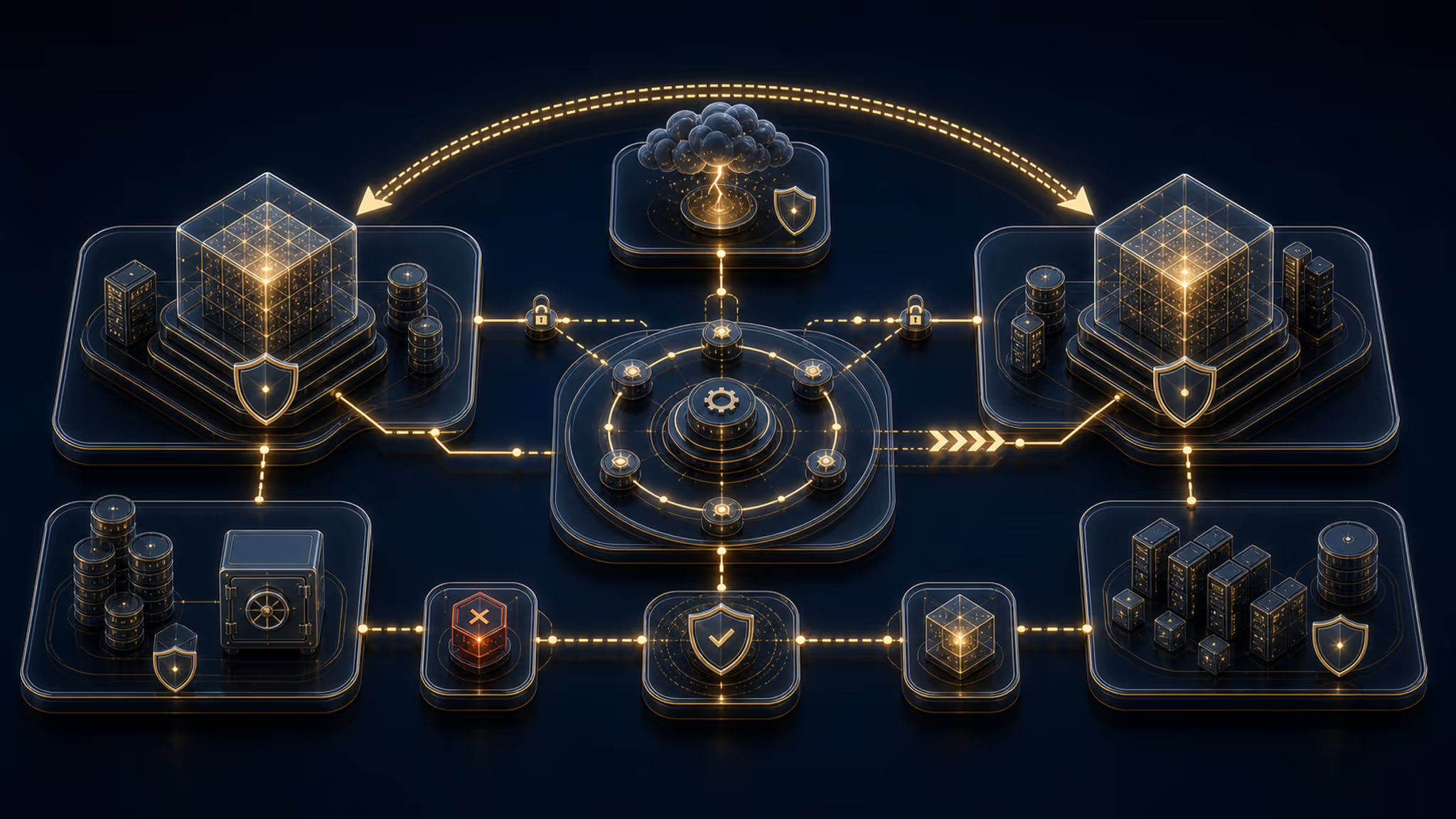
We bind recovery of critical systems to contracted RTO/RPO plans; cloud-based DR reduces site dependency, and periodic tests verify the plan against reality.
EVIDENCEISO 22301ISO 27001NIS2Scope record
01Current stateTopology, traffic, and dependency visibility.
02Target architectureSegmentation, capacity, and availability design.
03Controlled cutoverChange window, validation, and rollback plan.
04HypercareMonitoring, tuning, and operational handover.
POSITION
Where this service sits in the portfolio
SERVICE SCOPE
What this service addresses
The critical topics this service addresses and the outcome we deliver in each.
Recovery is tied to a contract
contract-scoped
We tie the recovery of critical systems within set target windows to contracted RTO/RPO plans; scope and acceptance criteria are defined in the contract.
Site dependency is reduced
evidence readiness
With a cloud DR (DRaaS) architecture we protect workloads under a single plan and configure replication and failover to reduce physical-site dependency.
The plan is validated by testing
contract-scoped
We validate the plan with non-disruptive failover tests and full failover simulation; a cadence of at least two non-disruptive tests and one full exercise per year is recommended.
Replication health is monitored
measured target
We monitor status with a replication-health dashboard and RPO-drift alerting, tracked through a baseline, target and review cadence.
Delivery model
Delivery approach
How we phase the service across delivery, governance, and connected service pillars.
01
Strategy and inventory: we design the DR strategy through a critical-system inventory, recovery prioritisation and RTO/RPO target setting.
02
DRaaS setup: with platform selection (Azure Site Recovery, Zerto, Veeam DR, AWS DR), replication policy and bandwidth planning we prepare failover/failback procedures and runbooks.
03
Test and monitor: we continuously validate the plan's realism with non-disruptive failover tests, a replication-health dashboard and RPO-drift alerting.
Operating contexts
Example operating contexts
Illustrative surfaces where this service is commonly activated.
Dependency on a single physical site
Organisations that do not want to stay tied to a single location during a disaster and plan to move to cloud DR.
Hybrid workload protection
Teams that want to protect on-premise and cloud workloads under a single DR plan.
Unvalidated DR plan
Organisations with DR infrastructure whose risk is unclear because it has not been validated with failover tests.
DEPTH
Technical and compliance depth
This service's depth on sector-specific technical and compliance topics.
DRaaS architecture
With VM replication, database log shipping and storage-level copy we design continuous, near-sync and async replication options by workload.
Orchestration and runbooks
With automatic failover sequencing and dependency management we set up runbook-based standard operations and speed up response.
Backup integration
We support integration with common backup solutions such as Veeam, Commvault and Rubrik, tying existing infrastructure into a single DR plan.
What It Solves
Traditional on-premises backup and recovery systems fail to meet modern RTO/RPO demands when ransomware, hardware failure, or data center outages strike at scale. Disaster Recovery as a Service (DRaaS) delivers cloud-native replication, automated failover, and verified recovery capabilities without the capital investment of a secondary data center. Our DRaaS solution closes the gap between IT recovery aspirations and the recovery reality organizations experience during actual incidents.
Cloud-based replication to Azure, AWS, or private cloud secondary sites
Automated failover targets for Tier-1 workloads defined by contracted RTO/RPO scope
Continuous replication with RPO targets as low as 15 seconds
Shorten operational cycle time against agreed measurement targets and acceptance criteria
Benefit
Make cost and resource optimization measurable against the agreed baseline and review cadence
Benefit
Pass compliance audits with quarterly tested and documented recovery proofs
Recovery Targets
RTO: <15 min (Tier-1), RPO: <15 sec (continuous replication)
Cloud Platforms
Azure Site Recovery, AWS DRS, Veeam Cloud Connect
Replication
Continuous, near-synchronous, and scheduled snapshot options
Testing
Automated quarterly DR test with zero production impact
Scope
Our DRaaS scope spans workload discovery, replication design, failover runbook development, and ongoing managed recovery testing. We support physical servers, virtual machines (VMware, Hyper-V), and cloud-native workloads across hybrid environments. Engagement starts with a DR readiness assessment that establishes current RTO/RPO baselines, identifies critical workload tiers, and defines the target-state architecture before any replication configuration begins.
Workload discovery and criticality tiering (Tier-1 through Tier-3)
DR architecture design for hybrid and multi-cloud environments
Failover runbook authoring with step-by-step recovery procedures
Managed DR testing cadence with executive-level reporting
Key Benefits
Benefit
Cover agreed Tier-1 workloads within the initial 90-day onboarding phase
Benefit
Shorten operational cycle time against agreed measurement targets and acceptance criteria
Benefit
Meet BDDK BT Yönetmeliği and ISO 22301 DR documentation requirements
VPN, ExpressRoute, and site-to-site IPSec for replication traffic
Security
Encrypted replication in transit (AES-256) and at rest
Monitoring
Contract-scoped replication health monitoring with alerting SLAs
Deliverables
DRaaS engagements deliver a fully operational cloud-based recovery environment, tested and documented to meet audit requirements, along with a managed testing program that ensures recovery capability remains current as environments evolve. Clients receive executive dashboards showing replication health, last tested recovery times, and compliance posture against agreed RTO/RPO targets. All deliverables are designed to satisfy regulatory examiners, internal audit teams, and insurance underwriters.
Configured and tested cloud DR environment aligned to agreed RTO/RPO tiers
DR runbooks with step-by-step failover and failback procedures
Quarterly DR test reports with evidence packages for audit and compliance
Executive DR posture dashboard with real-time replication health
Key Benefits
Benefit
Support audit and compliance readiness with evidence records instead of unsupported public outcome promises
Benefit
Improve annual DR test readiness with contractual evidence on test completion
Benefit
Maintain continuous compliance posture without seasonal scramble before audits
Test Frequency
Quarterly automated + annual full failover simulation
Reporting
Per-test PDF report + real-time dashboard (web portal)
SLA
Contracted service target set by tier, scope, and approved runbook
Does DRaaS require replacing our existing backup solution?
Not necessarily. DRaaS complements existing backup strategies by adding orchestrated failover and cloud-based replication layers. We assess your current backup architecture and integrate DRaaS at the recovery orchestration layer without disrupting day-to-day backup operations.
How is DRaaS different from cloud backup?
Cloud backup stores copies of data for restoration, which typically takes hours to days. DRaaS replicates entire workloads — including OS, applications, and data — to a live cloud environment that can be activated in minutes. DRaaS is the standard for organizations with aggressive RTO requirements.
Can DRaaS protect applications with complex dependencies?
Yes. Our runbook engine supports application-consistent failover sequencing — for example, database servers before application servers before web tiers. We map all inter-application dependencies during the design phase and encode them into the automated failover orchestration.
What network bandwidth is required for continuous replication?
Bandwidth requirements depend on data change rates (daily changed data volume). We perform a change rate analysis during the assessment phase and right-size the replication bandwidth. replication bandwidth is sized from measured change rates and agreed Tier-1 workload scope.
How long does a DRaaS test take and does it impact production?
Automated DR tests run in an isolated network bubble separate from production. Test windows, workload set, reporting timing, and disruption controls are confirmed during scope and acceptance planning.
What happens after a real disaster — how do we fail back to primary?
Timeline is confirmed during discovery based on scope, integration complexity, current maturity, and acceptance criteria. The project plan is tied to approved scope and dependencies.
Related service groups
Compare the other workstreams under the same pillar as well.