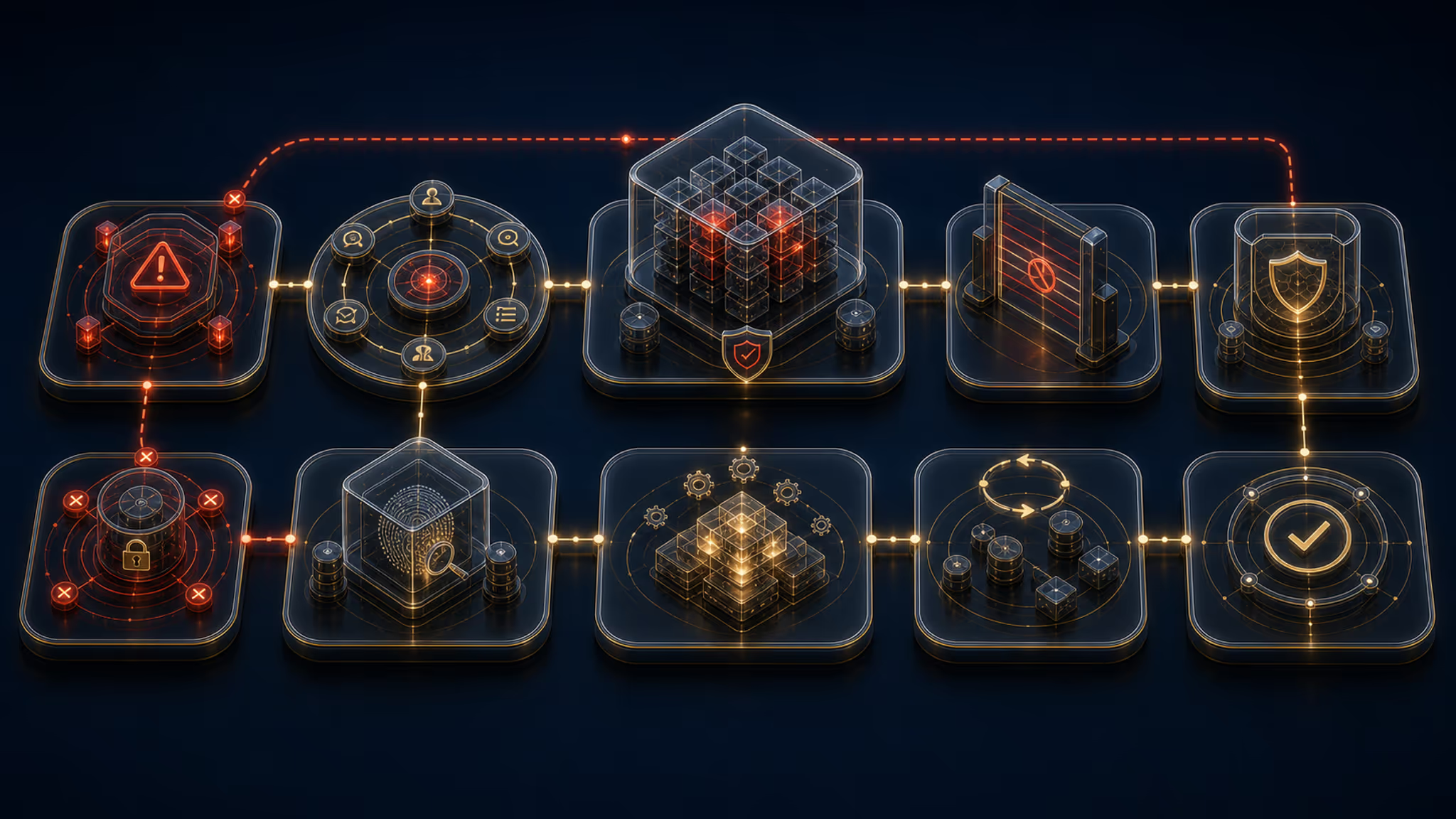
We stop the spread at the moment of attack, collect evidence, and protect business continuity; crisis communication keeps stakeholders accurately informed.
EVIDENCEISO 22301ISO 27001NIS2Scope record
01Current stateTopology, traffic, and dependency visibility.
02Target architectureSegmentation, capacity, and availability design.
03Controlled cutoverChange window, validation, and rollback plan.
04HypercareMonitoring, tuning, and operational handover.
POSITION
Where this service sits in the portfolio
SERVICE SCOPE
What this service addresses
The critical topics this service addresses and the outcome we deliver in each.
Spread is stopped early
measured target
With an incident response plan (IRP) and a retainer/SLA emergency response line we start initial containment remotely and aim to reduce dwell time.
Evidence that observes legal admissibility
evidence readiness
Our forensic processes follow chain-of-custody principles; evidence is delivered hash-verified and reported.
Defined response time via retainer
contract-scoped
An annual retainer agreement provides a contracted response time (SLA 2-4 hours) in emergencies; the scope is defined in the contract.
Alignment with regulatory notification
published after approval
We provide notification support aligned with KVKK and BDDK reporting windows; the final legal assessment is left to legal and compliance.
Delivery model
Delivery approach
How we phase the service across delivery, governance, and connected service pillars.
01
Preparation and containment: within the NIST SP 800-61 and SANS IR framework we start initial containment remotely with an incident response plan and playbooks, and dispatch an on-site team when needed.
02
Forensic analysis: with live-system and memory analysis, disk imaging, malware analysis and IOC extraction we identify the root cause and preserve chain of custody.
03
Crisis communication and closure: with stakeholder notification, regulatory notification support and a post-incident improvement roadmap we close the incident and capture lessons learned.
Operating contexts
Example operating contexts
Illustrative surfaces where this service is commonly activated.
Active cyber attack
Organisations that want to stop the spread and get coordinated response during an ongoing attack.
Forensic evidence need
Teams that need chain-of-custody evidence for court and cyber-insurance processes.
Ready response capacity
Organisations that want to set up a pre-defined SLA emergency response line through a retainer.
DEPTH
Technical and compliance depth
This service's depth on sector-specific technical and compliance topics.
Incident response lifecycle
We run the preparation, detection, containment, root cause, recovery and lessons-learned phases within the NIST SP 800-61 and SANS IR framework.
Forensic tooling
With Velociraptor, KAPE, FTK, EnCase and volatility we run memory forensics, disk imaging and network capture, and identify malware with YARA rules.
Notification and insurance documentation
With notification support aligned to KVKK 72-hour and BDDK reporting flows we prepare an incident report and evidence file in a format insurers will accept.
What It Solves
A cyber incident in the first 24 hours is defined by the decisions made and not made — wrong containment steps destroy forensic evidence, delayed stakeholder communication triggers regulatory sanctions, and uncoordinated technical response allows attackers to pivot deeper into the environment. Our Cyber Incident Response service provides immediate access to certified responders who can contain, investigate, and remediate security incidents while managing crisis communications and regulatory notifications in parallel. We eliminate the confusion and delays that turn manageable incidents into catastrophic breaches.
Contracted emergency incident response retainer with defined SLA activation
Digital forensics and evidence preservation aligned to legal chain-of-custody standards
Ransomware containment, decryption negotiation support, and recovery coordination
KVKK/GDPR breach notification drafting and regulatory communication management
Key Benefits
Benefit
Make risk and response indicators visible through measured controls, rehearsed playbooks, and evidence review
Benefit
Make risk, control, and compliance indicators visible through measured targets and evidence records
Benefit
Make operational speed, resilience, and response outcomes measurable through contracted scope and acceptance criteria
Activation SLA
Contracted service target set by tier, scope, and approved runbook
Cyber Incident Response covers three interconnected disciplines: technical investigation and containment, crisis communications management, and post-incident forensic reporting. Our response team operates as an integrated unit — technical analysts focus on network and endpoint forensics while a communications specialist coordinates internal and external messaging, regulatory notifications, and media relations if required. This parallel-track approach ensures that no crisis communication deadline is missed while technical response is underway.
Network traffic analysis, endpoint forensics, and malware reverse engineering
Crisis communication playbooks for board, employees, customers, and regulators
Legal hold procedures and evidence packaging for law enforcement or litigation
Post-incident root cause analysis (RCA) and lessons-learned facilitation
Key Benefits
Benefit
Prevent secondary incidents caused by incomplete remediation through structured evidence-based RCA
Benefit
Turn the outcome into a measurable target with baseline, owner, and review cadence
Benefit
Satisfy cyber insurance claim requirements with a comprehensive forensic investigation report
Investigation
Memory forensics, disk imaging, log analysis, network flow analysis
Chain-of-custody evidence packaging, court-admissible report format
Insurance
Cyber insurance claim support documentation and expert testimony
Deliverables
At the close of every incident response engagement, clients receive a comprehensive forensic investigation report documenting the attack timeline, indicators of compromise (IOCs), affected systems inventory, data impact assessment, and a prioritized remediation roadmap. This report serves regulatory notification obligations, insurance claims, board reporting, and internal audit requirements simultaneously. We also deliver a lessons-learned session to embed findings into updated security controls and response playbooks.
Forensic investigation report with attack timeline and IOC catalog
KVKK/GDPR breach notification drafts and regulatory submission records
Remediation roadmap with prioritized technical and process improvements
Updated incident response playbooks incorporating lessons from the incident
Key Benefits
Benefit
Satisfy regulatory documentation requirements within statutory timeframes (72 hours for GDPR/KVKK)
Benefit
Make risk and response indicators visible through measured controls, rehearsed playbooks, and evidence review
Benefit
Enable cyber insurance claim review with investigation reports structured for underwriter assessment
Report Format
Executive summary + technical appendix + IOC feed (STIX/TAXII)
Regulatory Docs
KVKK VERBIS notification, GDPR Art.33 form, sector-specific reports
IOC Sharing
MISP-compatible IOC export for SIEM ingestion
Playbook Update
Revised IR playbook in the agreed post-incident review window
Frequently Asked Questions
What is an incident response retainer and why do we need one?
A retainer is a pre-negotiated agreement that can provide priority access to our IR team when an incident occurs. Without a retainer, you compete with all clients for available responders during a crisis — which is the worst time to negotiate terms. Retainers also include proactive preparedness services like tabletop exercises and playbook reviews.
Can you respond to incidents caused by insider threats or accidental data loss, not just external attackers?
Yes. Our IR scope covers the full incident taxonomy: external attacks (ransomware, APT, phishing), insider threats (data theft, sabotage), accidental exposure (misconfigured cloud storage, email misdirection), and system failures with security implications. Each scenario has dedicated investigative and response procedures.
How do you manage communications with the media during a high-profile incident?
We provide a crisis communications specialist who works alongside your PR team or acts as the primary communications lead if one is not available. We use a hold-and-release protocol — no statement is issued until approved by both the technical team confirming factual accuracy and the legal team confirming liability exposure. All statements are logged for regulatory purposes.
What is the typical timeline from incident detection to full remediation?
Timeline depends heavily on incident complexity and scope. Ransomware incidents targeting a limited number of systems can be contained in 24-48 hours and fully remediated in 1-2 weeks. Advanced persistent threat (APT) investigations involving multi-month intrusions may require 4-8 weeks for full forensic investigation, though critical systems are restored within days.
Can the forensic report be used as evidence in legal proceedings?
Yes. Our forensic investigation reports are prepared following chain-of-custody standards and can be submitted as evidence in civil or criminal proceedings. We use court-admissible imaging tools, hash-verified evidence packages, and expert witness documentation. Our forensic analysts are available to provide expert testimony when required.
Do you share threat intelligence from our incident with other clients?
Never without explicit written consent. All incident data is treated as strictly confidential under NDA. We do participate in anonymized threat intelligence sharing programs (such as sector-specific ISACs), but only with your prior written authorization and with all identifying information removed before submission.
Related service groups
Compare the other workstreams under the same pillar as well.