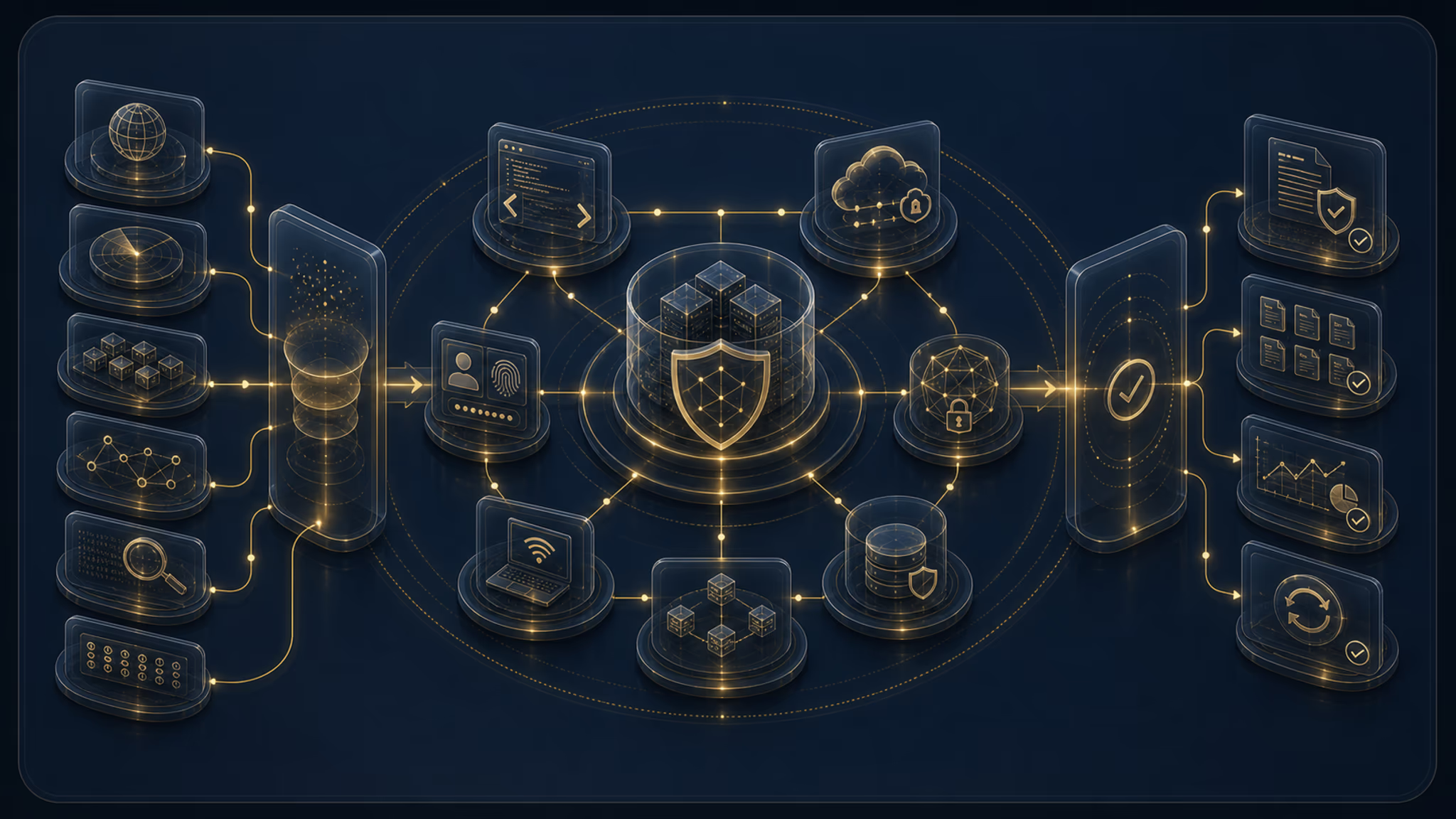
We run penetration tests and Red Teaming from the attacker's perspective; weaknesses are proven with real attack scenarios, and regular vulnerability management keeps security hygiene continuous.
EVIDENCEISO 27001KVKKNIS2DORA
01Current stateTopology, traffic, and dependency visibility.
02Target architectureSegmentation, capacity, and availability design.
03Controlled cutoverChange window, validation, and rollback plan.
04HypercareMonitoring, tuning, and operational handover.
POSITION
Where this service sits in the portfolio
SERVICE SCOPE
What this service addresses
The critical topics this service addresses and the outcome we deliver in each.
Risk proven with real scenarios
evidence readiness
We surface gaps through real attack scenarios and turn theoretical risk into concrete findings with POC evidence.
Prioritised remediation path
evidence readiness
We prioritise vulnerabilities with CVSS v3.1 scoring and clarify which gap to close first through a remediation guide.
Audit-ready reporting
contract-scoped
We provide evidence usable in compliance audits through an OWASP/MITRE-referenced technical report and an executive summary.
Remediation verified by re-test
contract-scoped
The first re-test is included in the project scope; we deliver an evidence-backed round that verifies the impact of fixes.
Delivery model
Delivery approach
How we phase the service across delivery, governance, and connected service pillars.
01
Scoping and rules of engagement: we define test windows and a rollback plan for critical systems and run the test in a controlled environment within predefined rules.
02
Adversarial simulation: we run external/internal network, web/mobile application, API and wireless tests, adding Red Team and Purple Team exercises as needed.
03
Reporting and verification: we deliver a POC-backed technical report, executive summary and prioritised vulnerability list, then verify fixes with a re-test.
Operating contexts
Example operating contexts
Illustrative surfaces where this service is commonly activated.
Regular penetration-testing obligation
Regulated organisations requiring at least one comprehensive pentest a year and application testing before every major release.
Realistic testing of the defence chain
Organisations wanting realistic Red Team scenarios that test the people, technology and process layers together.
Prioritising the gaps
Teams wanting to close found vulnerabilities quickly with CVSS-based prioritisation and a remediation guide.
DEPTH
Technical and compliance depth
This service's depth on sector-specific technical and compliance topics.
Methodology and scope
We run external/internal network, web/mobile application, API and wireless tests within OWASP, PTES, MITRE ATT&CK and NIST SP 800-115.
Red Team and Purple Team
Red Team tests the entire defence chain with realistic attack scenarios; Purple Team exercises improve it together with the defence team.
Experienced expert team
With experts holding OSCP, OSCE and CEH credentials we use tools such as Burp Suite, Nmap, Metasploit and Nuclei.
What It Solves
Defensive security controls cannot be validated without adversarial testing. Organisations that rely solely on vulnerability scanning and compliance checkbox audits may have critical exploitable weaknesses that remain undetected until a real attacker discovers them. Our Offensive Security practice conducts structured penetration testing, Red Team operations, and continuous vulnerability management programmes that reveal real-world attack paths and provide evidence-based remediation priorities before adversaries can exploit them.
Network, web application, and API penetration testing to CREST and OWASP standards
Red Team engagements simulating advanced persistent threat (APT) tactics
Purple Team exercises to improve detection coverage alongside Red Team activity
Continuous vulnerability management with risk-scored asset inventory
Key Benefits
Benefit
Identify and remediate critical vulnerabilities an average of 4 times faster than reactive patch processes
Benefit
Turn the outcome into a measurable target with baseline, owner, and evidence review cadence
Benefit
Make risk and response indicators visible through measured controls, rehearsed playbooks, and evidence review
Testing Standards
CREST, CHECK, PTES, OWASP Testing Guide v4.2
Pentest Tools
Burp Suite Pro, Cobalt Strike, Metasploit, BloodHound, Impacket
Vuln Management
Tenable Nessus, Qualys VMDR, Rapid7 InsightVM
Red Team Frameworks
MITRE ATT&CK, Atomic Red Team, TIBER-EU framework
Scope
Offensive security engagements are scoped based on your risk profile, regulatory requirements, and business objectives. We cover external and internal network testing, web and mobile application assessments, cloud configuration review, social engineering, and physical security assessments. Vulnerability management scope spans the full asset lifecycle from discovery through to remediation verification.
External attack surface assessment and exposure discovery
Social engineering simulations including phishing, vishing, and physical access
Remediation tracking and re-testing to verify fix effectiveness
Key Benefits
Benefit
Satisfy regulatory and cyber insurance requirements with CREST-certified penetration test reports
Benefit
Shorten operational cycle time against agreed measurement targets and acceptance criteria
Benefit
Validate detection controls against real threat actor techniques through structured Purple Team sessions
Certifications
CREST CRT, CREST CCT, OSCP, OSEP, GPEN, GXPN
Social Engineering
GoPhish, SET (Social Engineering Toolkit), custom pretexting
Cloud Assessment
ScoutSuite, Prowler, Pacu (AWS), Steampipe
Asset Discovery
Shodan, Censys, BBOT, Amass, Nmap
Deliverables
Our offensive security deliverables are designed for dual audiences: technical remediators who need precise reproduction steps and vulnerability details, and executives and auditors who need risk-summarised reports with business impact context. All reports meet CREST reporting standards and are suitable for direct submission to regulatory bodies and cyber insurance underwriters.
Executive summary report with risk-rated findings and business impact statements
Technical findings report with CVSS scores, reproduction steps, and remediation guidance
Attack narrative for Red Team engagements documenting the full kill chain
Remediation verification report after client fixes are implemented
Key Benefits
Benefit
Support audit and compliance readiness with evidence records instead of unsupported public outcome promises
Benefit
Make risk, control, and compliance indicators visible through measured targets and evidence records
Benefit
Demonstrate continuous security improvement to the board with year-over-year vulnerability trend analysis
Encrypted PDF, secure client portal with role-based access
Finding Tracking
Plextrac, Dradis Pro, or integration with your existing defect tracker
Re-test Window
90-day re-test included for all Critical and High findings
Frequently Asked Questions
What is the difference between a penetration test and a Red Team engagement?
A penetration test is a time-boxed, scope-defined exercise to identify and exploit vulnerabilities within an agreed boundary, typically completed in 1 to 3 weeks. A Red Team engagement is a longer, goal-based operation (typically 4 to 12 weeks) that simulates a full APT attack lifecycle including initial access, persistence, lateral movement, and objective achievement, with only senior leadership aware of the exercise. Red Team exercises test your detection and response capabilities, not just your defences.
How do you ensure penetration testing does not cause disruption to production systems?
We operate under a formal rules of engagement document agreed in advance, which defines excluded systems, permitted testing hours, exploitability thresholds for production systems, and emergency stop contacts. Destructive or denial-of-service test techniques require explicit written approval for each system. We maintain a test action log throughout the engagement for full transparency and root cause analysis in the event of an unplanned incident.
How frequently should organisations conduct penetration testing?
We recommend a minimum of annual penetration testing for the external perimeter and critical applications, with additional tests triggered by significant infrastructure changes, major application releases, or post-incident reviews. Organisations in regulated sectors such as finance, healthcare, and critical infrastructure often require quarterly testing or continuous red team operations to meet supervisory expectations.
Can you conduct penetration testing against cloud-hosted applications and APIs?
Yes. Cloud and API penetration testing is a core competency. We test RESTful and GraphQL APIs against OWASP API Security Top 10, assess OAuth and JWT implementation flaws, and evaluate cloud-specific misconfigurations such as overly permissive IAM roles, public S3 buckets, and metadata service exploitation. Testing is conducted within the bounds of the cloud provider's penetration testing policy and applicable rules of engagement.
How are penetration test findings integrated with our vulnerability management programme?
We deliver findings in both human-readable PDF format and structured data format (JSON/XML) compatible with vulnerability management platforms such as Tenable, Qualys, and Rapid7. Findings are tagged with asset identifiers from your CMDB, enabling direct import into your existing remediation workflow without manual re-entry.
Is a re-test included after we remediate the vulnerabilities found?
Yes. A single re-test for all Critical and High severity findings is included within the agreed response window of the original report delivery at no additional cost. The re-test validates that the specific vulnerability has been remediated and produces an updated findings status report suitable for audit submission. Additional re-tests beyond the included cycle are available at a reduced rate.
Related service groups
Compare the other workstreams under the same pillar as well.