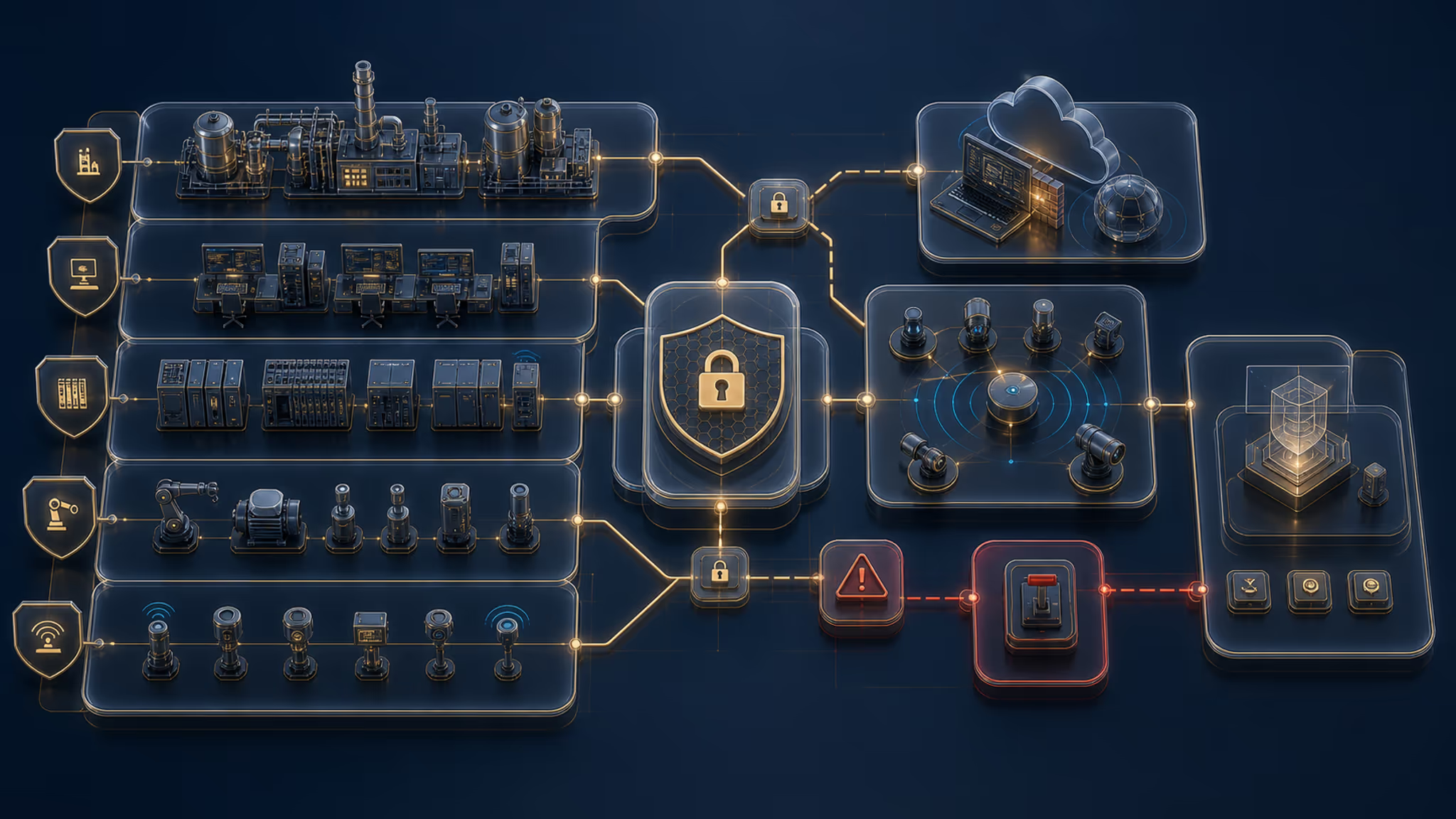
We protect SCADA, PLC, and DCS systems against cyber threats; we sharpen the IT/OT boundary and add security layers without endangering production continuity.
EVIDENCEISO 27001KVKKNIS2DORA
01Current stateTopology, traffic, and dependency visibility.
02Target architectureSegmentation, capacity, and availability design.
03Controlled cutoverChange window, validation, and rollback plan.
04HypercareMonitoring, tuning, and operational handover.
POSITION
Where this service sits in the portfolio
SERVICE SCOPE
What this service addresses
The critical topics this service addresses and the outcome we deliver in each.
Improvement without production downtime
contract-scoped
We apply all changes within planned maintenance windows and improve security without affecting production using passive monitoring tools.
Full OT asset visibility
evidence readiness
Through passive network discovery we inventory SCADA, PLC, DCS, HMI and RTU assets and produce a risk map.
Controlled IT-OT data flow
contract-scoped
With a Purdue-model-referenced IT-OT DMZ design we establish controlled and secure data flow at the boundary.
IEC 62443 compliance readiness
measured target
Through maturity assessment and gap analysis we produce a compliance roadmap aligned with IEC 62443 and leave the formal audit and approval to an accredited third party.
Delivery model
Delivery approach
How we phase the service across delivery, governance, and connected service pillars.
01
Discovery and inventory: with passive network listening (SPAN/TAP) and asset profiling we inventory OT assets and build a risk map.
02
Segmentation: we design a Purdue-model Level 0-5 referenced IT-OT DMZ and OT-specific access control.
03
Monitoring and compliance: we set up threat monitoring with OT IDS/IPS and behavioural anomaly detection and produce a compliance roadmap with IEC 62443 gap analysis.
Operating contexts
Example operating contexts
Illustrative surfaces where this service is commonly activated.
Protecting legacy OT systems
Facilities wanting to protect legacy PLC and SCADA systems that cannot be patched directly through segmentation and anomaly detection.
Clarifying the IT-OT boundary
Manufacturing organisations wanting controlled data flow and a clear security boundary between IT and OT networks.
Industrial compliance readiness
Critical-infrastructure operators wanting maturity assessment and gap analysis for compliance with standards such as IEC 62443.
DEPTH
Technical and compliance depth
This service's depth on sector-specific technical and compliance topics.
OT asset discovery
With passive network listening and asset profiling we inventory SCADA, PLC, DCS, HMI, historian and RTU assets without affecting production.
Purdue-model segmentation
We structure the IT-OT boundary with a Purdue-model Level 0-5 referenced industrial DMZ and OT-specific firewall.
OT-specific monitoring
With tools such as Nozomi Networks, Claroty or Dragos we provide anomaly detection suited to Modbus, OPC-UA, S7 and DNP3 protocols.
What It Solves
Critical infrastructure operators face a converging threat landscape where IT-side compromises increasingly pivot into operational technology networks, threatening physical processes, safety systems, and continuous operations. Legacy OT environments were designed for reliability and availability, not cybersecurity, leaving SCADA systems, PLCs, and HMIs exposed to modern threat actor techniques. Our OT/ICS Industrial Security practice provides visibility, segmentation, and monitoring capabilities that protect operational technology without compromising the reliability requirements that production environments demand.
OT asset discovery and inventory using passive monitoring to avoid process disruption
IT/OT network segmentation design aligned to IEC 62443 and NIST SP 800-82
OT-specific threat monitoring and anomaly detection deployment
Industrial incident response planning and OT-aware forensics capability
Key Benefits
Benefit
Shorten operational cycle time against agreed measurement targets and acceptance criteria
Benefit
Improve quality indicators through baselines, acceptance criteria, and reviewed evidence
Benefit
Turn the outcome into a measurable target with baseline, owner, and evidence review cadence
OT Monitoring
Claroty, Dragos Platform, Nozomi Networks Guardian, Tenable OT
Our OT/ICS security engagement covers the full programme from initial risk assessment and asset inventory through to segmentation architecture, monitoring deployment, incident response planning, and operator training. We work alongside your engineering and operations teams to ensure security controls are appropriate for your specific industrial processes and do not introduce operational risk. The scope includes both legacy SCADA environments and modern IIoT deployments.
SANS ICS curricula, CISA ICS-CERT training, vendor-specific operator training
Deliverables
OT/ICS security deliverables are engineered for the unique audience of industrial cybersecurity: they must serve both cybersecurity professionals and operational engineering teams who may have limited security background. Documentation is written in process-aware language, and all recommended controls are evaluated for operational feasibility before inclusion in deliverables.
OT asset inventory with network topology diagrams and zone/conduit documentation
IEC 62443 gap assessment report with security level targets and remediation roadmap
OT incident response plan with industrial-specific playbooks for common attack scenarios
Quarterly OT security posture report with anomaly trend analysis
Key Benefits
Benefit
Meet NIS2 Article 21 and NERC CIP audit requirements with complete IEC 62443-aligned documentation
Benefit
Make risk and response indicators visible through measured controls, rehearsed playbooks, and evidence review
Benefit
Obtain cyber insurance coverage for OT assets with documented security programme evidence
Zone Documentation
IEC 62443-3-2 zone and conduit model, Purdue Model diagrams
Can cybersecurity tools be deployed in OT environments without risking production disruption?
Yes. OT security is specifically designed around the principle of passive, non-intrusive monitoring. Asset discovery and threat detection tools operate by analysing network traffic using a tap or SPAN port without sending any probes or packets into the OT network. This eliminates any risk of disrupting PLCs, RTUs, or safety systems that may be sensitive to unexpected network traffic.
How do you handle patching in OT environments where systems cannot be taken offline for updates?
OT patch management requires a fundamentally different approach to IT. We implement a compensating controls strategy where systems that cannot be patched are protected through network segmentation, application whitelisting, and enhanced monitoring. Patches are validated in an offline test environment that mirrors the production OT configuration before a scheduled maintenance window deployment, minimising patch-induced process disruptions.
How do you manage third-party vendor access to OT environments securely?
We implement an OT-specific privileged access management solution that provides time-limited, session-recorded remote access through a secure gateway. Vendor connections are restricted to specific assets and protocols by policy, session recordings are retained for forensic purposes, and all access requires multi-factor authentication and approval from an OT security administrator before the session is established.
What is your approach to securing legacy PLCs that cannot run security agents?
Legacy PLCs and other agent-hostile devices are secured through the network layer rather than the device itself. We implement network microsegmentation to restrict communication to authorised protocol and address pairs, deploy passive anomaly detection to identify deviations from normal communication patterns, and use application whitelisting at the network layer to block unauthorised commands or firmware updates.
How are OT security deliverables kept separate from IT security documentation for compliance purposes?
We maintain separate documentation repositories for OT and IT security programmes, aligned to the distinct regulatory frameworks applicable to each domain. OT documentation follows IEC 62443 structure, while IT documentation follows ISO 27001. A cross-reference index is maintained to identify shared controls and avoid duplication while preserving the independence required by each framework.
Can the OT incident response plan be integrated with our existing corporate incident response programme?
Yes. We design OT incident response as an annex to the corporate IRP, using the same escalation structure and severity taxonomy but with OT-specific decision points and containment procedures. The integration ensures that when an OT incident is declared, the corporate IR team activates standard crisis communications and business continuity procedures while OT specialists manage the technical response independently.
Related service groups
Compare the other workstreams under the same pillar as well.